Sarana Davaa
Project Background
Before the Verkada 3.0 redesign, security alerts — motion detection, door tampering, vape detection, and more — were scattered across individual product pages, one design per product line. There was no single place to see everything happening across a site, which made triage and investigation slower than it needed to be.
The new Alerts Page consolidates every alert type into a single, unified hub — improving visibility, streamlining investigations, and reducing the cognitive load of piecing together an incident from multiple disconnected views.
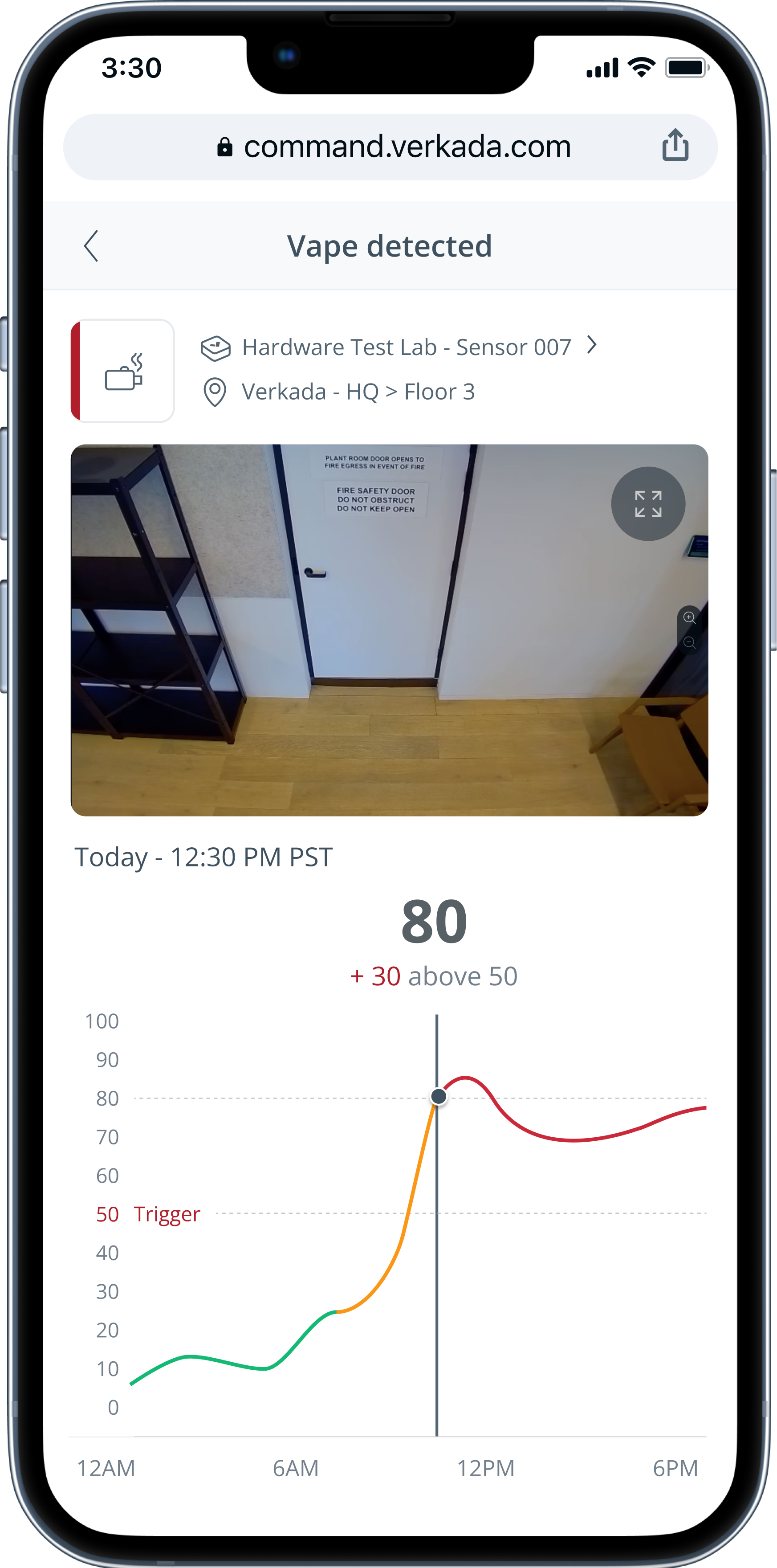
As the lead designer, I owned the migration of every existing alert type into one consistent system: unifying the design language across products, optimizing for mobile, and rethinking what information an alert actually needs to surface to be useful in the moment.
Key Problems
Inconsistent design patterns.
Every product team had built its own alert UI independently — different layouts, different terminology, different levels of detail — so users had to relearn the interface every time they moved between alert types.
Not mobile-optimized.
Alerts are often acted on in the moment, away from a desk. Several existing designs weren’t responsive, which directly undercut that use case.
Lack of contextual information.
Alerts frequently didn’t include enough detail for a user to judge urgency or decide on next steps without leaving the alert to dig elsewhere.
Goals
- Create one consistent alert design that still flexes to each product’s specific needs
- Ensure full responsiveness and usability on mobile
- Surface clear, contextual detail so users can act without hunting for more information
Framing: What Does an Alert Actually Need to Tell You?
I broke this down into four questions every alert needed to answer, regardless of product line:
[One or two sentences: how did you land on these four specifically — user interviews, support ticket patterns, stakeholder input?]
Final Design
The final design applies this consistent four-part structure across every alert type, replacing the fragmented per-product patterns with one system that scales as new alert types get added.
[One sentence on a specific trade-off or constraint you navigated — e.g., a product team that pushed back on losing their custom layout, or a technical limit on what data was available for certain alert types.]
Outcome
- ✓ Consistent layout across all alert types
- ✓ Improved contextual information and support for taking action
- ✓ Mobile experience optimized
[Add one number or scale statement if you have it — how many alert types were migrated, how many products/customers this shipped to, or any usage/support-ticket shift you’re aware of.]
Reflection
[2 sentences: one thing you’d do differently, one thing it taught you.]